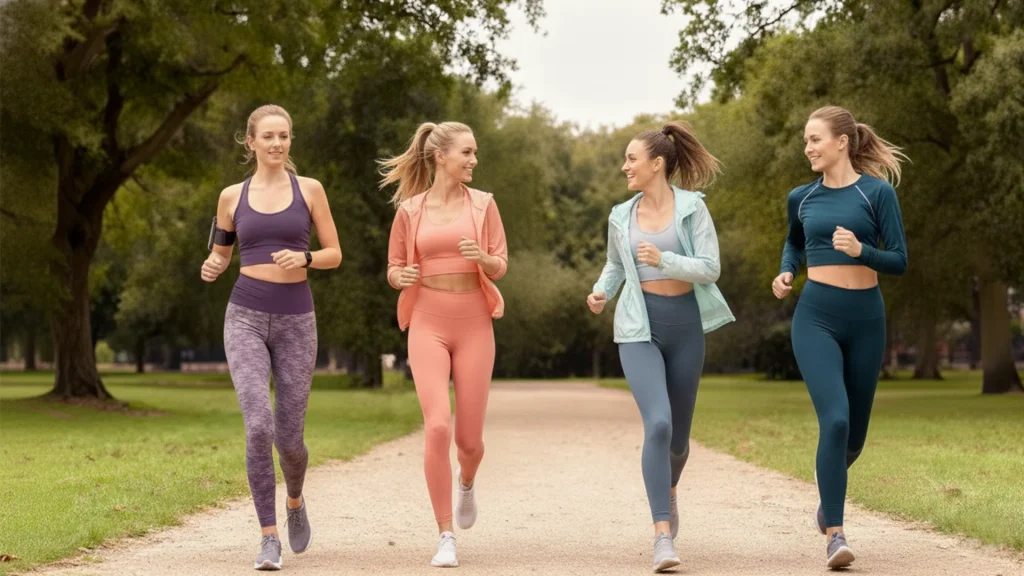

Start with three base fibers: polyester, nylon (polyamide) and their blends with spandex. For leggings and sports bras, nylon-spandex gives the softer hand and better recovery; for sublimation-printed activewear, polyester-spandex takes ink far better; for swim, polyester-spandex resists chlorine longer while nylon-spandex feels smoother. That is the short answer. The rest of this guide explains the weight, knit, finish and printing decisions behind it — and how to read a supplier’s “poly-spandex” label without guessing.
The Three Base Fibers (and What Each Brings)
Almost every performance fabric is built from one or two base fibers, elasticized with a small percentage of spandex.
- Polyester: strong, quick-drying, wrinkle-resistant and cost-effective. It holds shape well and takes digital prints better than any other fiber. Its weakness is a slightly drier, less soft hand feel.
- Nylon / Polyamide: softer, smoother and more abrasion-resistant than polyester, with a cooler hand feel. It is the premium choice for close-fitting activewear and swimwear. It costs more and is less heat-stable than polyester.
- Spandex / Elastane (Lycra): never used alone. Added at roughly 10–25% it provides the stretch and recovery that lets a garment move and snap back.
So “polyester-spandex” and “nylon-spandex” simply describe which base fiber is paired with spandex.
Activewear Fabrics Compared
Once you know the base fibers, the next question is which finished fabric to pick. Here is how the six most common activewear and swimwear fabrics compare:
| Fabric | Typical composition | Weight range | Stretch | Pros | Cons | Best for |
|---|---|---|---|---|---|---|
| Polyester/spandex | 80–90% poly, 10–20% spandex | 180–320 gsm | 4-way | Cheap, colorfast, quick-dry, holds print well | Less soft hand-feel, retains odor | Leggings, tees, tennis dresses |
| Nylon/spandex | 75–85% nylon, 15–25% spandex | 200–300 gsm | 4-way | Soft, strong, great recovery, matte look | Pricier, slower to dry, harder to print | Premium leggings, sports bras |
| Cotton/spandex | 90–95% cotton, 5–10% spandex | 180–280 gsm | 2-way | Natural feel, breathable | Absorbs sweat, shrinks, fades | Casual athleisure, hoodies |
| Recycled polyester/spandex | 80–90% rPET, 10–20% spandex | 180–320 gsm | 4-way | Same performance as virgin poly + sustainability story | Higher MOQ, needs GRS chain of custody | Eco-positioned brands |
| Polyester/PBT swim knit | 80–85% poly, 15–20% PBT | 170–220 gsm | 2-way | Chlorine resistant, shape retention | Less soft than nylon swim | Training swimwear |
| Nylon/spandex swim | 80–82% nylon, 18–20% spandex | 190–230 gsm | 4-way | Luxe feel, great fit | Chlorine degrades it faster | Fashion swimwear |
gsm = grams per square meter. Higher gsm generally means more opacity and structure — critical for leggings.
The 80/20 rule of thumb: for most performance leggings, an 80–87% polyester or nylon base with 13–20% spandex, at 220–280 gsm, is the safe starting point. Everything else is tuning.
Polyester-Spandex vs Nylon-Spandex: Which Should You Choose?
| Property | Polyester-Spandex | Nylon-Spandex |
|---|---|---|
| Hand feel | Drier, crisper | Softer, smoother, cooler |
| Abrasion resistance | Good | Excellent (best for leggings) |
| Digital print quality | Best — sharpest, most vivid | Good but less vivid |
| Color retention | Very good | Can yellow with age/light |
| Cost | Lower | Higher |
| Best for | Printed activewear, tops, price-sensitive lines | Leggings, sports bras, swimwear, premium lines |
Rule of thumb: if the garment is printed and price-sensitive, lean polyester-spandex. If it must feel premium and survive heavy abrasion (leggings, swim), lean nylon-spandex.
Digital Printing: Why Polyester-Spandex Wins
Digital printing on synthetic activewear uses disperse dyes. Disperse dye molecules are small and travel into the fiber under heat, bonding best with polyester. That is why polyester-spandex is the most suitable fabric for digital printing — colors come out sharper, more saturated and more durable.
Nylon can be digitally printed, but the color is generally less vivid and requires more careful processing. If your collection depends on bold prints, specify polyester-spandex for the printed panels.
Reading Performance Claims Without Being Misled
Fabric suppliers love performance buzzwords. Here is what the common claims actually mean — and the questions that separate real performance from marketing:
Moisture-wicking / quick-dry. The fabric moves sweat away from skin and evaporates it fast. It is largely a function of polyester content and knit structure. A “moisture-wicking cotton” claim deserves skepticism — cotton absorbs; it does not wick.
Four-way stretch. Stretches both crosswise and lengthwise, and recovers. Pull a swatch hard in both directions and watch it snap back. Poor recovery = baggy knees after one wear. Spandex content below 10% rarely gives true 4-way performance.
UPF 50+. Blocks 98% of UV rays. Ask whether it is inherent to the knit (denser = better) or a chemical finish (washes out over time). For swim and tennis lines, inherent UPF from tight construction is more durable.
Chlorine resistant. Polyester/PBT blends genuinely resist chlorine; standard nylon/spandex does not — it goes brittle and translucent with regular pool use. Match the fabric to the use case.
Anti-static / anti-odor. Usually a chemical finish. Ask how many washes the finish survives — many wash out within 10–20 cycles.
Rule: if a performance claim matters to your brand promise, ask for the test report (AATCC, ISO, or equivalent). A factory that can produce reports is a factory that actually controls its supply chain.
Single Knit (Jersey) vs Interlock: Which Is Better?
This is one of the most misunderstood choices, and it matters a lot for quality.
- Single knit (single jersey): knitted on one needle bed. It shows “V” stitches on the face and loops on the back. It is lighter, thinner and generally more breathable (often under 180–200 gsm) and is usually blended with spandex for stretch. It is stretchier in one direction and good for lightweight tops and t-shirts, but it curls at the cut edges and is less dimensionally stable than interlock.
- Interlock: knit on two sets of needles that interlock two jersey layers back-to-back, so both faces look identical and smooth. It is denser and heavier (typically 200–340 gsm), more dimensionally stable, resists twisting and shrinkage better, and offers better opacity and a firmer shape recovery. It does not curl at the edges.
Interlock is generally the better choice for activewear and swimwear because it resists show-through, holds compression and keeps its shape through repeated wear and washing — all critical for leggings, sports bras and training sets.
Surface Finishes: Brushing, Peaching and More
After knitting, fabric can be finished to change how it feels and performs:
- Brushed / sanded: the surface is mechanically brushed with fine rollers to raise a soft nap that traps warm air. Single-sided brushing softens mainly the inside; double-brushed raises both faces for an ultra-soft, warmer, more premium feel — popular in cold-weather activewear. Because more loose fibres sit on the surface, brushed fabrics (especially double-brushed) are more prone to pilling, so specify an anti-pill finish where it matters.
- Peached / sueded: a finer, softer version of brushing for a smooth, silky touch.
- Matte / delustered: reduces shine for a subtle, premium look — common in leggings.
- Anti-pilling, moisture-wicking and quick-dry finishes: functional treatments that improve durability and comfort.
What Works for Each Category
Leggings / yoga pants. Nylon/spandex (premium hand-feel, best recovery) or polyester/spandex (better price, better printability). 220–280 gsm for squat-proof opacity. Avoid cotton blends for true performance positioning.
Sports bras. Nylon/spandex for support and softness; higher spandex content (20–25%) for high-impact styles.
Tennis dresses / training tops. Lightweight polyester/spandex (180–220 gsm) for breathability and print vibrancy.
Swimwear. Training/competition: polyester/PBT for chlorine resistance. Fashion/resort: nylon/spandex for feel — but warn customers it is not for daily lap swimming.
Hoodies / casual athleisure. Cotton/polyester fleece blends (280–400 gsm). Performance is not the promise here — comfort and wash durability are.
Nylon 6 vs Nylon 66: What Is the Difference?
Nylon is not one material. The two common types are:
- Nylon 6 (PA6): made from caprolactam. Softer, more elastic, easier to dye and more cost-effective — the standard nylon for most activewear and a favourite for next-to-skin comfort.
- Nylon 66 (PA66, also written Nylon 6.6): made from hexamethylenediamine and adipic acid. Its more regular, crystalline molecular structure gives it higher tensile strength, better abrasion resistance, a higher melting point and better shape retention than nylon 6, though it feels slightly stiffer and is harder to dye. It is the premium nylon, used for high-performance and durable activewear and outdoor gear.
Neither nylon is simply “better” — it depends on the goal. Choose Nylon 66 for maximum durability, compression and heat resistance; choose Nylon 6 for the softest hand feel, greater stretch and easier dyeing. When a supplier offers Nylon 66, they are offering a higher-grade, higher-cost nylon worth specifying for premium compression and demanding swim lines.
How to Choose: A Quick Framework
- Define the end use. Swim, gym training, yoga or lifestyle? Each has different demands for stretch, chlorine/salt resistance and hand feel.
- Pick the base fiber. Printed and price-led → polyester-spandex. Premium and abrasion-heavy → nylon-spandex.
- Choose the knit. Interlock for structure and compression; single knit (jersey) for light tops. Request swatches from the factory’s stock library first — faster and lower MOQ than custom development.
- Add the finish. Brushed for warmth and softness; matte for a premium look.
- Confirm with a sample. Always test the actual fabric for stretch, recovery, pilling, colorfastness and print quality before bulk production. Test like a customer — wash swatches 3+ times, stretch them hard, and squat-test the sewn garment (not just flat fabric). Then lock the bulk lot: approve the lab dip and confirm the bulk fabric lot matches the approved swatch.
Sustainable Fabrics: Worth It?
Recycled polyester (rPET) and organic cotton are the two credible options:
- rPET/spandex performs nearly identically to virgin polyester and gives a genuine sustainability story — but typically requires GRS chain-of-custody certification: higher MOQs, longer lead times, documented segregation.
- Organic cotton works for casual athleisure but not for performance (same sweat-absorption problem as conventional cotton).
Honest advice: do not lead with sustainability unless your customer will pay for it. rPET adds 10–20% to fabric cost and complicates MOQs.
How Vista Clothing Helps You Choose
Vista Clothing is a Quanzhou-based activewear and swimwear manufacturer serving global brands since 2013. We help brands select the right fabric, knit, finish and printing method for their market, then develop the garment end to end.
- Fabric guidance across polyester-spandex, nylon-spandex and Nylon 66 (PA66)
- Single knit (jersey), interlock, brushed and matte finishes
- Digital printing on the most suitable base fabric for sharp, durable color
- Full OEM/ODM and private-label support, MOQ 100 pcs per style per color
- Samples in 7–10 working days; bulk production typically 25–40 calendar days after approval
Tell us your product and target market, and we will recommend the fabric that performs best for it.
Frequently Asked Questions
Is polyester-spandex or nylon-spandex better for leggings?
Nylon-spandex is generally better for leggings because it is softer, more abrasion-resistant and feels cooler against the skin. Polyester-spandex is a cost-effective alternative and prints better, but feels drier.
Why is polyester best for digital printing?
Digital printing uses disperse dyes, which bond best with polyester under heat. This gives sharper, more vivid and more durable prints than on nylon or natural fibers.
What is the difference between single knit and interlock?
Single knit (also called jersey) is a single-faced knit — lighter and stretchier, common in tops. Interlock is denser and more stable, better at holding shape and preventing show-through, which suits activewear and swimwear.
What is Nylon 66?
Nylon 66 (PA66) is a higher-grade nylon, a higher-grade nylon with greater strength, abrasion resistance and heat stability than standard Nylon 6. It is used in premium, high-performance activewear.
Is UPF 50+ permanent?
Only if it comes from the knit construction itself (tight, dense fabric). Chemical UV finishes degrade with washing — typically noticeable after 20–30 cycles.
Can I use the same fabric for leggings and sports bras?
Often yes — many brands run both from the same nylon/spandex base to consolidate MOQs. Bras may need a higher-spandex variant for support bands.
How do I know if a fabric is really squat-proof?
Stretch the sewn garment (not the flat fabric) over skin or a form and check opacity under bright light. Specify your opacity requirement to the factory in writing.
Does recycled polyester feel different from virgin polyester?
To the wearer, essentially no. The differences are in cost, MOQ, certification paperwork — and your marketing story.
What gsm should I choose for leggings?
220–280 gsm is the sweet spot: opaque without being heavy. Below 200 gsm risks sheerness; above 300 gsm gets hot and restrictive.
Next Steps: From Fabric to Production
Once you have shortlisted your fabrics, the next questions are cost and timeline. Our Activewear & Swimwear MOQ Guide explains how minimum order quantities are calculated, and our Sampling, Cost and Lead-Time Guide walks you through getting from first sample to bulk production. Ready to start? Contact Vista Clothing for fabric recommendations and a free quote.
Need help choosing fabric for your next activewear or swimwear collection? Contact Vista Clothing for fabric recommendations and a free quote.
Ready to Start Your Custom Collection?
Get a free quote and sample from a China OEM/ODM activewear and swimwear manufacturer. Low MOQ from 100 pieces, private label and full customization.
Browse the fabrics we use in production: Vista Fabric Library → | Compliance & testing: Certifications →
Related product categories: